When Hackers Target Freezers: What Healthcare Cold-Chain Leaders Must Learn From the Recent Cyberattacks
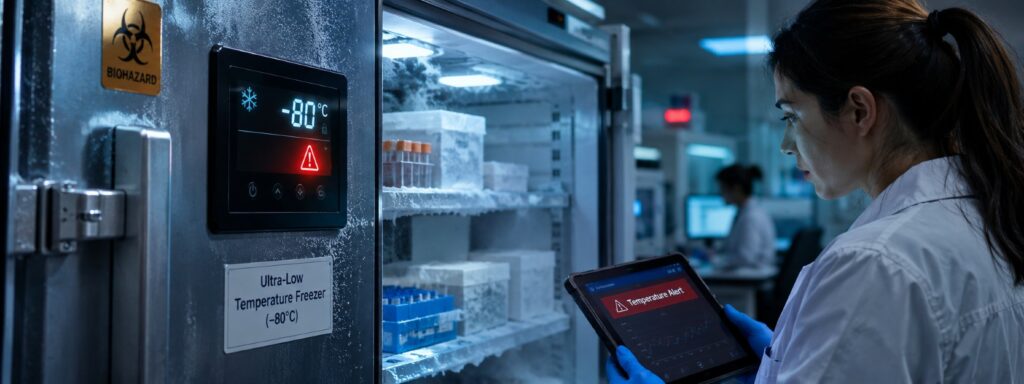
The attempted sabotage of blood-storage refrigeration in France reveals why cybersecurity, independent temperature visibility, and rapid exception response must work together to protect healthcare operations.
A Cyberattack That Could Have Become a Healthcare Crisis
On November 2, 2026, a cyberattack against a refrigeration equipment supplier reached three cold-storage facilities operated by France’s national blood service, Établissement français du sang (EFS).
The attackers remotely manipulated temperature and defrost settings to extreme levels, threatening storage environments containing plasma intended for transfusions and pharmaceutical manufacturing.
Fortunately, the outcome was very different from what the attackers may have intended.
Monitoring systems detected the abnormal conditions, enabling technicians to intervene, secure the affected equipment, and transfer stored products where necessary. EFS reported no blood-product losses, no identified health consequences, and no interruption to its blood collection and distribution services. [1]
The incident followed a series of attacks on refrigeration systems at European supermarkets, where remotely altered settings and forced defrost cycles resulted in significant food losses. [2]
For healthcare organizations, the message is difficult to ignore.
If a remotely controlled freezer can be manipulated without anyone physically accessing the facility, protecting the contents requires more than reliable refrigeration equipment.
It requires secure control systems, trustworthy monitoring, timely alerts, and people prepared to act.
The French incident demonstrated the importance of that last line of defense.
The Emerging Threat: When Digital Vulnerabilities Create Physical Losses
Cyberattacks against healthcare organizations are often associated with stolen patient records, ransomware, or disrupted hospital information systems.
But connected refrigeration introduces another kind of exposure.
A compromised control system can potentially change the physical conditions under which critical medical materials are stored.
Cybersecurity specialists call these environments operational technology (OT): systems that monitor or control physical equipment and processes.
In healthcare, OT can include refrigeration controllers, building management systems, environmental controls, and other connected infrastructure.
The distinction matters because an OT cyberattack can create a physical consequence even when no medical records are stolen.
The cybersecurity company Claroty, commenting on the November attacks, warned that the refrigeration controllers involved in commercial environments also have applications in healthcare, including storage of vaccines, blood products, pharmaceuticals, and clinical materials. [3]
Its assessment highlights a particular vulnerability: refrigeration equipment may be maintained through remote connections operated by external contractors, sometimes outside the visibility of a healthcare organization’s central IT security team.
The Cloud Security Alliance similarly identified shared controller technologies, third-party remote access, and limited overnight staffing as factors that can make refrigeration incidents particularly difficult to contain. [4]
The lesson is not that all connected refrigeration equipment is unsafe.
It is that every connected cold-chain asset introduces operational dependencies that must be understood, secured, and monitored.
What Could a Similar Attack Cost a Healthcare Organization?
The EFS incident did not result in documented product losses. That is an important fact.
But it also provides an opportunity to examine what could happen if a similar attack went undetected or the response was delayed.
Consider the different environments that depend on reliable refrigeration.
| Healthcare environment | Potential consequence of a prolonged storage failure |
| Blood banks and plasma storage | Product quarantine or loss, supply disruption, and additional transfers |
| Hospital pharmacies | Temperature-sensitive medicine exposure, replacement costs, and treatment scheduling disruption |
| Diagnostic laboratories | Reagent or specimen exposure, testing delays, and possible recollection |
| Clinical research facilities | Loss of research materials, study delays, and investigation costs |
| Pharmaceutical 3PL facilities | Inventory exposure, customer-service interruption, recovery costs, and contractual consequences |
These are potential impacts, not reported outcomes of the French incident.
For a healthcare organization, the business cost of a serious refrigeration event may involve several components:
Total incident exposure = Inventory loss + Investigation labor + Recovery logistics + Service disruption + Remediation costs
Not every excursion results in product disposal. Product disposition should follow approved quality procedures, stability evidence, and relevant manufacturer guidance.
Nevertheless, delayed detection can increase uncertainty and make recovery more expensive.
A refrigerator containing $100,000 of temperature-sensitive inventory does not automatically create a $100,000 loss when an excursion occurs. But it does create a material exposure that management should understand before an incident.
And when several facilities depend on the same remote-access provider or controller technology, a single cyber vulnerability may affect multiple assets at once.
This is why the issue deserves attention from COOs, laboratory directors, pharmacy leaders, quality teams, and IT security—not just facilities maintenance.
Five Lessons Healthcare Cold-Chain Leaders Should Take Seriously
1. Protecting the controller is essential. Monitoring the outcome is equally important.
The first responsibility is to prevent unauthorized access.
Healthcare organizations should work with their IT and OT security teams to assess internet-facing refrigeration controllers, vendor access, software vulnerabilities, network segmentation, and authentication controls.
The U.S. Department of Health and Human Services (HHS) recommends cybersecurity practices addressing known vulnerabilities, multifactor authentication, supplier risk, asset inventories, and incident preparedness. [5]
But even well-protected systems can fail through equipment faults, human error, or unforeseen cyber incidents.
That makes continuous monitoring of actual storage conditions an important additional safeguard.
Where practical, an independently powered and separately secured monitoring path can help detect temperature deviations even when the primary refrigeration control system is compromised.
Important: An independent monitoring path must be genuinely independent of the vulnerable controller, its alarm configuration, and relevant communication dependencies. Simply connecting another dashboard to the same compromised data source does not provide that protection.
2. An alert is only valuable when someone can act on it.
One of the most significant lessons from France is that the incident was detected early enough for staff to intervene.
For healthcare organizations, the questions are operational:
Who receives a temperature alert at 2 a.m.? What happens if that person does not respond? Can the facility identify affected inventory quickly? Is an alternative storage location available?
Monitoring without a response procedure may provide a record of a loss rather than an opportunity to prevent one.
3. Fixed cold-chain assets need the same attention as shipments.
Healthcare organizations often invest in temperature visibility during transportation.
Yet refrigerators, freezers, cold rooms, and other stationary storage assets may operate under separate monitoring systems and procedures.
This creates the potential for fragmented information across the cold chain.
A shipment may arrive within its required temperature range, only for the receiving storage equipment to experience an undetected problem later.
Cold-chain integrity does not end when the delivery is completed.
It must continue through receiving, storage, handling, and subsequent movement.
4. Third-party dependencies deserve operational scrutiny.
The EFS incident reportedly originated through a refrigeration supplier rather than a direct compromise of the blood service’s own systems. [1]
This should prompt healthcare organizations to examine the suppliers and contractors with access to their critical equipment.
Who can remotely change refrigeration settings? Which vendors maintain those connections? Who is notified if a supplier experiences a cyber incident?
These questions belong in vendor-risk assessments and business-continuity planning.
5. Recovery readiness matters as much as detection.
Even an effective alert cannot protect medical inventory if there is no practical response.
Organizations should know which materials are most critical, where they can be transferred, who authorizes those transfers, and how temperature and custody evidence will be maintained during recovery.
The French response illustrates the importance of connecting detection with decisive operational action.
Where Akurasense® Can Strengthen Cold-Chain Resilience
Akuratemp’s Akurasense® Cold Chain Operational Intelligence Platform addresses an important part of this challenge: visibility into temperature-sensitive assets and the workflows used to manage exceptions.
Akurasense is a sensor-agnostic, asset-first platform designed to bring supported monitoring data, alerts, asset information, operational events, and reporting into a more consistent environment.
For healthcare organizations, this creates several opportunities.
Continuous fixed-asset monitoring. Supported refrigerators, freezers, and laboratory storage assets can be monitored for temperature deviations, helping teams identify conditions that require attention.
Timely exception visibility. Configured alerts can notify responsible personnel when monitored conditions move outside defined thresholds, supporting earlier intervention.
Documented response. Teams can record actions associated with an exception, helping operations and quality personnel reconstruct what happened and how it was handled.
Connected fixed and mobile cold-chain workflows. Monitoring information from storage assets and transportation workflows can be brought into a more unified operational view, reducing dependence on disconnected records.
Operational improvement. Historical exception data can help teams investigate recurring problems and prioritize improvements to equipment, procedures, and response workflows.
There is, however, an essential distinction.
Akurasense is not a replacement for OT cybersecurity controls, and it does not prevent unauthorized manipulation of refrigeration equipment.
Nor should organizations assume that a sensor-agnostic platform automatically provides an independent cybersecurity-resilient monitoring channel.
That capability depends on the selected sensors, connectivity, architecture, access controls, and system configuration.
A well-designed deployment can complement cybersecurity measures by providing additional temperature visibility and operational evidence. The architecture should be assessed to determine whether monitoring remains available if the primary controller, network, or supplier system is compromised.
This is where Akuratemp can contribute alongside healthcare IT, facilities, quality, and security teams.
A Practical Cold-Chain Cyber-Resilience Checklist
Healthcare organizations do not need to wait for another incident to assess their exposure.
A useful starting point is a focused review of critical fixed-storage assets.
| Priority | Recommended action |
| Identify | Inventory critical refrigerators, freezers, cold rooms, their controllers, monitoring devices, and responsible owners |
| Secure | Have IT/OT teams review remote access, vendor permissions, exposed interfaces, authentication, and known vulnerabilities |
| Verify | Determine whether temperature monitoring and alarms remain trustworthy if the primary controller is compromised |
| Respond | Test after-hours alerts, escalation procedures, backup storage availability, and inventory transfer plans |
| Improve | Review exception records, recurring equipment issues, response times, and opportunities to connect monitoring workflows |
One particularly useful exercise is a tabletop scenario:
At 2 a.m., a remote attacker changes the setpoint of a freezer containing critical medical materials. The equipment’s normal management interface is no longer trustworthy.
Can your team independently verify the actual storage temperature? Who receives the warning? Who can isolate the affected equipment? How quickly can the contents be secured?
If those answers are unclear, the organization has a practical resilience gap worth addressing.
The Bigger Lesson: Cold-Chain Resilience Requires More Than Cybersecurity
The recent freezer cyberattacks demonstrate that a digital compromise can threaten physical healthcare assets.
But the French blood-service incident also provides a constructive lesson.
The monitoring and response arrangements helped prevent a potentially serious loss.
For healthcare organizations, the objective should not be to choose between cybersecurity and cold-chain monitoring.
It should be to combine them.
Secure the equipment and its remote connections. Monitor the physical conditions. Make exceptions visible. Prepare people to respond. Preserve the evidence needed to understand and improve operations.
Because the true measure of cold-chain resilience is not simply whether an incident occurs. It is whether the organization can detect, contain, and recover from it before patient care is affected.
Is Your Fixed Cold Chain Prepared for the Unexpected?
Akuratemp can help healthcare organizations assess temperature-monitoring visibility across fixed and mobile cold-chain assets, identify operational gaps, and explore how Akurasense® can support earlier exception detection and more consistent response workflows.
Request a Cold-Chain Visibility Assessment today!
Sources and Further Reading
[1] Établissement français du sang (EFS), November 3, 2026. Official statement on the cybersecurity incident affecting a refrigeration equipment supplier.
https://presse.efs.sante.fr/actualites/l-efs-confirme-l-incident-de-cybersecurite-impactant-un-de-ces-prestataires-d-equipement-frigorifique-2c07c-08a0a.html
Additional reporting: Associated Press — Cyberattack hits French blood bank site
[2] BBC News, November 4, 2026. Reporting on the freezer attacks and potential perpetrators.
https://www.bbc.com/news/articles/c8vgxyvz6y9ro
[3] Claroty, November 4, 2026. The Physical Cost of Digital Attacks on Healthcare OT and Building Management Systems.
https://claroty.com/blog/the-physical-cost-of-digital-attacks-on-healthcare-ot-and-building-management-systems
[4] Cloud Security Alliance, November 3, 2026. When Fridges Fail Together: Correlated OT Risk in Supermarket Refrigeration.
https://labs.cloudsecurityalliance.org/research/csa-research-note-refrigeration-ot-correlated-risk-20261103/
[5] U.S. Department of Health and Human Services. Healthcare and Public Health Cybersecurity Performance Goals.
https://hhscyber.hhs.gov/cybersecurity-performance-goals.html
[6] Akuratemp. Akurasense® Cold Chain Operational Intelligence Platform.
https://www.akuratemp.com/akurasense/