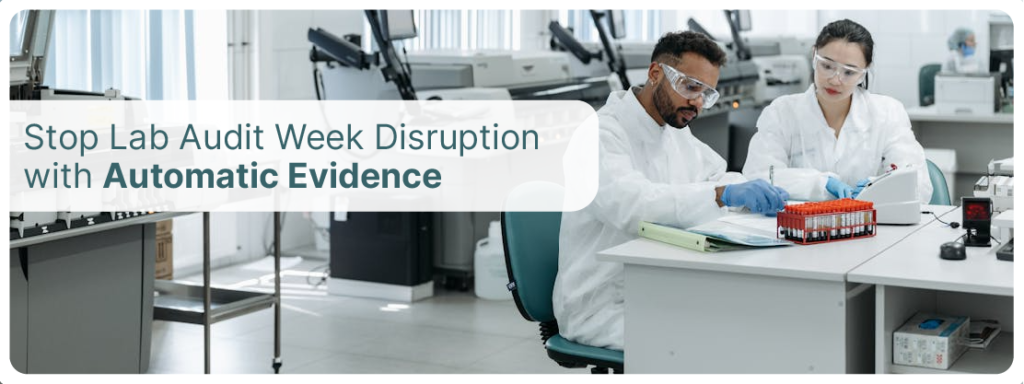
Stop Lab Audit Week Disruption with Automatic Evidence
Most teams don’t struggle to collect temperature data.
They struggle to prove control quickly when it matters—during Contract Renewal, Customer Satisfaction & Trust, and Service Level Agreements (SLA).
When evidence lives in five places (device portals, screenshots, spreadsheets, email threads, training folders), every incident becomes a coordination storm:
- People chase “the right version” of the log
- Decisions stall while facts are unclear
- Corrective actions get delayed
- Repeat issues persist because learnings aren’t standardized
That’s the hidden cost of audit prep: not the inspection itself—the operational disruption and repeat work leading up to it.
The fix is straightforward. Stop treating temperature logs as “records” and start treating them as proof-of-performance generated through repeatable evidence.
Proof is not paperwork—it’s contract defense
Customers rarely leave after one incident. They leave after repeated uncertainty like:
- Inconsistent answers
- Slow investigations
- Unresolved root causes
- “We can’t prove it” moments
A standardized evidence shortens disputes and protects renewals because you can show what happened—quickly and consistently.
What the business actually needs
Audits tend to go smoothly when your operation can demonstrate:
- Defined procedures
- Consistent monitoring
- Documented exception handling
- Corrective and preventive actions
- Trained/competent personnel
- Trustworthy devices/sensors
Instead of scrambling to assemble these pieces later, you build a bundle that’s produced the same way every time.
The Evidence Bundle
This is the Clinical Laboratory Improvement Amendments (CLIA) aligned bundle structure to standardize across sites and routes.
1) Trip Proof (the “what happened” layer)
- Shipment ID and route/origin/ destination
- Pickup to receipt time window
- Temperature profile (graph) and thresholds used
- Alarms/excursions (start/end/duration)
- Location/dwell context (where time accumulated, if available)
2) Exception Record (the “so what?” layer)
For every excursion or alert that matters operationally, record:
- What triggered it (threshold, duration)
- Who reviewed it (their role and timestamp)
- Decision taken (accept / hold / reject / recollect as per policy)
- Customer notification (if applicable)
- Final closure note
This is where “we saw it” becomes “we controlled it.”
3) CAPA Packet (the “we fixed it” layer)
Audits go badly when teams stop at “we investigated.” Here are some simple and consistent Corrective and Preventive Action (CAPA) steps:
- Containment action
- Root cause
- Corrective action
- Preventive action
- Effectiveness check (did repeats reduce?)
4) Training and competency evidence (the “people” layer)
A common gap is assuming training emails are “good enough.”
CMS explicitly differentiates training vs. competency assessments and notes that moderate/high complexity labs must demonstrate and document competency, including defined procedures such as direct observation, review of QC/maintenance records, and problem-solving assessment. Bundle items:
- Role-based SOP training completion
- Competency documentation where applicable
- Incident-linked refresher training (CAPA-triggered)
5) Device calibration and maintenance evidence (the “tooling trust” layer)
Your data is only as defensible as your device governance. Bundle the below listed items to make your monitoring credible under scrutiny:
- Device inventory and assignment rules
- Calibration/verification records per your policy and device requirements
- Maintenance records and “out of service” handling and replacement steps
6) SOP references (the “procedure anchor” layer)
Link each bundle element back to the SOP that governs it.
Why this pays back even if you ignore compliance
Standardized evidence reduces operational waste:
- Investigations become faster and less disruptive
- Escalations close quicker because proof is consistent
- Repeat incidents drop because CAPA is structured and tracked
- Multi-site performance becomes easier to manage and compare
Compliance becomes the value-added service. Audit readiness happens as a byproduct of controlled operations.
Akuratemp® helps convert “monitoring” into a repeatable evidence system:
- Akurasense® organizes shipment data into consistent, exportable records—so proof isn’t trapped in screenshots.
- Workflow standardization ensures the bundle is produced the same way across routes, shifts, and sites—so evidence gaps don’t return to the next audit.
Evidence Readiness Audit
Most teams don’t feel the cost of evidence gaps until audit week—or a major escalation. Simply drop a request for an Evidence Readiness Audit and we’ll contact you to help you map the hidden operational loss in your exception workflow (coordination calls, manual checking, repeat incidents) and recommend an action plan: what to standardize, what to automate, and how to turn monitoring into day-to-day operational advantage—with compliance as the silent value-add.