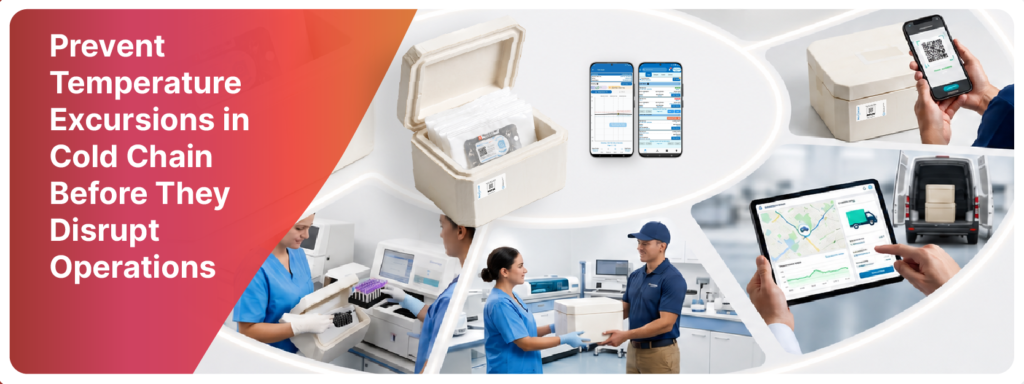
Prevent Temperature Excursions in Cold Chain Before They Disrupt Operations
Most cold-chain teams are not short on alerts. They are short on time.
By the time a temperature alert fires, the specimen has often already entered the risk zone. The courier may be mid-route. The tote may already be delayed at a handoff. The parcel may be sitting at a facility. The lab team may not see the full picture until receipt.
That is the problem with reactive cold-chain management: it tells you when something has already started going wrong.
For healthcare labs and networks, that is not just a quality concern. It is a business problem. Reactive alerts create investigation work, turnaround time (TAT) instability, recollection risk, customer escalations, and preventable route exceptions that teams have to keep absorbing.
The next level of cold-chain maturity is not more alerts. It is earlier intelligence. That is where route risk scoring comes in.
What is an intelligent cold chain?
Intelligent cold chain is the practice of using historical route, asset, temperature, dwell, handoff, and exception data to identify where a shipment is likely to run into risk before that risk becomes an excursion.
In simpler terms: instead of waiting for a shipment to go out of range, you study the conditions that usually lead to out-of-range events and build controls around them.
This matters because temperature excursions are rarely random. They usually have patterns.
- A particular tote or shipper is utilized with inadequately conditioned refrigerants
- A specific route runs late on certain days.
- A pickup site creates long staging dwell before the courier arrives.
- A handoff point repeatedly creates custody gaps.
- A particular tote or shipper underperforms under certain ambient conditions.
- A receiving location creates delays during peak windows.
- A route that looks safe in winter becomes risky in summer.
When these patterns are invisible, teams keep reacting. When these patterns are scored and managed, teams can prevent.
Why reactive alerts is where you should start
Reactive alerts are a critical part of any cold-chain operation. They tell teams when a shipment, asset, storage unit, or route event needs attention. Without alerts, operators are left waiting until receipt, customer escalation, or audit review to discover that something went wrong.
For specimen transport, that real-time visibility at each handoff matters. An alert at each handoff can help a team intervene earlier, protect a shipment that is approaching risk, document what happened, and make a faster decision at receipt. It turns temperature monitoring from a passive record into an active operating control.
But alerts become even more valuable when teams do not treat them as isolated events.
Every alert carries a signal. It tells you something about the handoffs along a route, the dwell point, the asset, the packaging workflow, or the storage environment. When those signals are reviewed over time, they help operations leaders move from incident response to process improvement.
The first value is faster investigation. When an alert is connected to time, temperature, location context, custody events, and asset identity, the team does not have to rebuild the story from screenshots, calls, and spreadsheets. They can quickly understand where the risk appeared and what decision needs to be made.
The second value is better operational consistency. When alerts are reviewed through a standard workflow, receiving teams and operations teams can respond the same way across sites and shifts. That helps protect TAT, reduce confusion, and make exception handling less dependent on who happens to be on duty.
The third value is learning. If the same route, dwell point, handoff, or asset type keeps producing alerts, the alert history becomes a roadmap for continuous improvement. Instead of closing each event and moving on, the team can identify recurring risk patterns and decide what needs to change in the workflow.
This shifts the operating question from:
“What happened to this shipment?”
to:
“What are our alerts telling us about route, asset, dwell, and custody risk over time?”
That is the foundation of a more proactive cold-chain operating model. Not by replacing reactive alerts, but by using them as structured signals for better route risk review, asset performance analysis, and continuous improvement.
What is route risk scoring?
Route risk scoring is a structured way to assign a risk level to a specimen transport route or lane based on known risk factors.
A route risk score does not need to start as a complex AI model. In most healthcare cold-chain operations, the first useful version can be built with practical inputs the team already understands: route history, dwell time, number of handoffs, temperature performance, asset reliability, seasonal exposure, and exception frequency.
The purpose is not to create a perfect prediction. The purpose is to prioritize attention.
- A low-risk route may only need standard monitoring and routine review.
- A medium-risk route may need earlier alerts, tighter staging controls, or a different pickup window.
- A high-risk route may need packaging changes, route redesign, additional custody checkpoints, or an SOP intervention before the next failure.
That is where ROI appears: you stop spreading effort evenly across every route and focus improvement where the business is already losing time and trust.
The five risk dimensions to score
A practical route risk model should be easy for operations, quality, and logistics teams to understand. It should not feel like a black box. The best place to start is with five dimensions.
1. Route history risk
Route history risk looks at how often a route or lane has generated exceptions in the past.
This includes temperature excursions, late pickups, delayed receipts, missed scans, unresolved custody gaps, and repeated customer escalations. A route with recurring issues deserves a higher risk score even if the last shipment was fine.
The key idea is simple: past operational friction often represents future operational friction unless something changes.
2. Dwell risk
Dwell risk measures where time accumulates in the journey.
Dwell can happen before pickup, during staging, at a hub, during a courier stop, at a cross-dock, or before receipt. Many teams blame “transport” for excursions, but the risk may actually occur while the specimen is waiting within an asset.
This is why dwell points are so important. A route with short drive time can still be high risk if specimens sit too long in uncontrolled staging. A longer route may be lower risk if the asset stays sealed, conditioned, and in control throughout the journey.
Dwell risk turns hidden waiting time into a measurable operational variable.
3. Handoff risk
Handoff risk measures how many custody transfers happen and how consistently they are documented.
Every handoff is a point where accountability can weaken. A specimen moves from collection site to a lockbox staging area, lockbox staging area to a courier tote, courier tote to vehicle mounted freezer, vehicle mounted freezer to parcel shipper, and finally to receiving at central lab.
The more handoffs a route has, the more important it becomes to capture who had custody, when custody changed, and whether the asset stayed within the approved temperature range at the handoff.
A route with visible handoffs is easier to defend. A route with unclear handoffs is harder to investigate and more likely to create disputes.
4. Asset risk
Asset risk measures how the transport or storage asset performs.
This is where Akurasense’s asset-first approach becomes important. The risk is not in the specimen or the driver, it is in the asset and workflow.
A lockbox, medical courier tote, home care courier tote, parcel shipper, refrigerated vehicle, and fixed storage unit all behave differently. They have different thermal profiles, different custody points, different failure modes, and different evidence requirements.
A tote that repeatedly shows temperature drift under certain conditions should not be treated the same as a high-performing tote. A refrigerated vehicle with frequent door-cycle risk should not be managed the same way as fixed storage. A parcel shipper with long transit windows needs different guardrails than a courier tote used for local pickups.
Asset performance validation helps teams identify whether the problem is a route problem, a workflow problem, or an asset performance problem.
5. Environmental and seasonal risk
Environmental risk considers the conditions surrounding the route.
Summer heat, winter cold, severe weather, long outdoor exposure, facility loading patterns, and air or parcel network delays can change the risk profile of the same route.
A route that is stable for six months of the year may become unstable during seasonal peaks. A route that performs well in mild conditions may need a different packaging profile or earlier alert logic during extreme weather.
An intelligent cold chain does not treat a route as static. It treats risk as dynamic.
A simple route risk scorecard
A practical route risk score can start with five inputs:
- Route history risk
- Dwell risk
- Handoff risk
- Asset risk
- Environmental/seasonal risk
Each input can be scored from 1 to 5.
- 1 means low risk.
- 3 means moderate risk.
- 5 means high risk.
- A route with a total score of 5 to 10 may be considered low risk.
- A route with a score of 11 to 17 may be considered medium risk.
- A route with a score of 18 to 25 may be considered high risk.
The exact thresholds should be adapted to the lab network, specimen types, service levels, and operational realities. The goal is not to create a universal formula. The goal is to create a consistent decision framework.
Once the score exists, teams can apply different operating rules.
- A low-risk route may use standard monitoring and weekly review.
- A medium-risk route may require tighter staging checks and earlier alert thresholds.
- A high-risk route may require a route redesign, asset change, conditioning change, handoff control, or Optymize workflow review.
This is how risk scoring becomes operational—not theoretical.
What route-risk review looks like in the real world
Imagine a lab network with several pickup sites feeding a central lab.
Site A has stable pickups and consistent staging. The courier arrives within a predictable window, the medical courier tote is used as intended, and temperature records show consistent performance. This site does not need extra operational complexity. It needs routine monitoring, standard review, and continued discipline.
Site B is the same distance from the lab, but specimens often wait in staging before the courier arrives. Over time, the temperature records show drift during the pre-pickup period, not during the drive. A basic alert may describe the event as a “temperature issue,” but the operational review tells a more useful story: this is likely a staging dwell time problem.
Site C has multiple custody transfers. It may not show frequent temperature excursions, but every exception takes too long to investigate because handoff records are inconsistent. This route may not be high thermal risk, but it is a high evidence-risk workflow..
Site D performs well most of the year but becomes less stable during summer or peak-volume periods. The review should not wait for a major excursion before action is taken.
This is the power of a more mature cold-chain operating model: it helps teams stop treating every exception as a surprise. The goal is not to replace real-time alerts. The goal is to learn from them, connect them to asset and workflow performance, and use that learning to reduce repeat exceptions over time.
Why analytics matter
An alert is a moment. Analytics reveal patterns.
That distinction is important because a cold-chain operation does not improve by acknowledging more alerts. It improves by learning which alerts should never have happened in the first place.
Cold Chain Operational Intelligence Platform powered by AkurasenseTM creates temperature visibility across assets, and workflow to measure the reliability of cold chain performance. Cold Chain Process Optimization Service powered by OptimyzSM utilizes all the data collected to analyze root cause of excursions and provide recommendations for improvement. That turns monitoring data into a continuous improvement engine.
Once leaders can see those patterns, improvement becomes targeted. Teams stop guessing. They stop applying the same fix everywhere. They focus on the specific failure mode that is driving cost.
Redesign the process behind the risk
Risk scoring helps identify where risk exists. OptimyzSM helps redesign the process so risk does not keep repeating.
This is important because a risk score by itself does not solve the problem.
If a route has high dwell risk, OptimyzSM can help map the current-state workflow and redesign the staging and pickup process.
If a route has high handoff risk, OptimyzSM can help define the custody workflow, handoff responsibilities, and exception escalation steps.
If a route has high asset risk, OptimyzSM can help standardize asset assignment, conditioning, pack-out, and readiness checks.
If a route has high seasonal risk, OptimyzSM can help define when packaging profiles or thresholds should change.
In other words, Akurasense shows where performance is breaking. OptimyzSM helps fix the workflow that causes the break. That is the combination healthcare cold-chain teams need: analytics plus process discipline.
Request a Route Risk Audit
If your team is still relying on reactive alerts, it may be time to understand where risk is building before the next excursion. Request a Route Risk Audit from Akuratemp.
We’ll review your specimen transport workflow across routes, dwell points, handoffs, and asset performance. Then we’ll help you build a practical risk scorecard and identify which operating changes can reduce rework, stabilize TAT, and prevent repeat exceptions.
Because the goal is not to respond faster after failure.The goal is to prevent avoidable cold-chain failures before they disrupt the business.