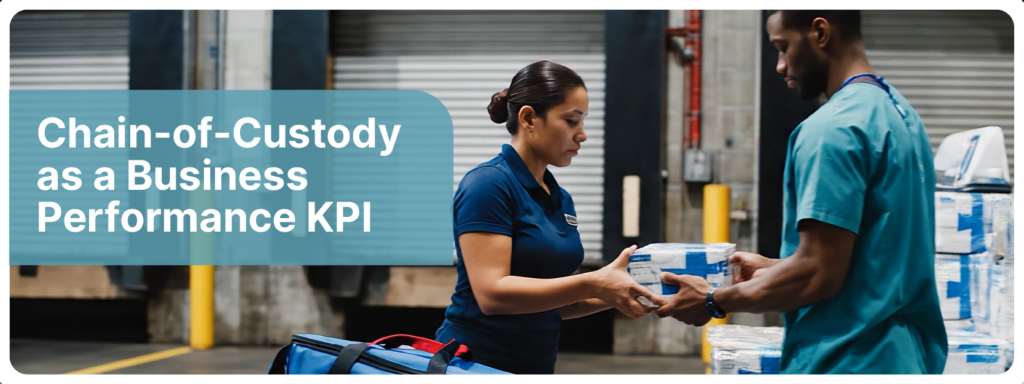
Chain-of-Custody as a Business Performance KPI: Turning Every Shipment into a Verifiable Operational Asset.
Cold-chain leaders like you already know the conversation that happens when something goes sideways: “Can you prove what happened—where, when, and for how long?”
Not a summary. Not a promise. Proof.
Because your customers aren’t buying a box or a route. They’re buying confidence—that time, temperature, location, and custody stayed controlled from pickup to receipt. When you can’t produce that proof quickly, the cost shows up as operational drag: escalations, manual investigations, disputes, credits, and slower renewals.
That’s why chain-of-custody shouldn’t live only in compliance binders. It should be treated like what it really is: An business performance KPI.
Why “proof” is becoming a business requirement
In healthcare logistics, accountability is shifting from “do your best” to “show your work.”
Across labs and biospecimen environments, chain-of-custody is explicitly framed as recording transfers—every move, every handoff—so integrity can be demonstrated, not assumed.
And in specimen workflows, there’s growing emphasis on capturing transport time and receipt timing (so you can calculate and defend the journey window).
Even in CLIA-focused guidance, the pre-analytical phase is tied to written procedures and monitored quality indicators—meaning the expectation isn’t just that you transported correctly, but that you can demonstrate control as a managed process.
Business translation: When you make proof easy to produce, you reduce the cost of every exception—because you eliminate ambiguity.
The real cost of weak chain-of-custody
When proof is incomplete or hard to assemble, you pay for it repeatedly through:
- Investigation labor: teams reconstruct journeys from texts, calls, screenshots, and partial logs
- Decision delays: accept/reject decisions stall because the facts aren’t clear
- Disputes and credits: “he said / she said” becomes expensive
- Customer friction: escalations escalate faster when you can’t show evidence
- Process stagnation: repeat issues persist because root cause stays unclear
Most leaders try to solve this with “more reporting.” But the win isn’t more reports. The win is a standardized Proof Packet that can be generated consistently—every shipment, every route, every time.
What is a “Proof Packet”?
A Proof Packet is a standardized, exportable bundle of evidence that answers four customer questions in minutes:
- Where was it? (location trail + timestamps)
- What happened thermally? (temperature profile + thresholds + duration)
- Who had custody when? (handoff timeline)
- What did you do about it? (exceptions + decisions + corrective action)
Think of it like an “invoice for trust.”
If you can produce it quickly and consistently, you stop spending time arguing about the journey and start improving the journey.
Chain-of-Custody as a KPI: What to measure
Treating chain-of-custody as a KPI doesn’t mean adding bureaucracy. It means tracking a few practical measures that reduce operational waste:
KPI 1: Proof Packet Completeness Rate
% of shipments with a complete packet (custody + time + temperature + location).
Why it matters: incomplete proof is where escalations begin.
(CAP chain-of-custody guidance emphasizes recording transfers and evidence of movement.)
KPI 2: Time-to-Proof (TTP)
How long it takes your team to produce the packet when a customer asks.
Why it matters: every hour you spend reconstructing a story is avoidable labor.
KPI 3: Exception-to-Closure Time
From first alert to documented close (decision + notes + preventive step).
Why it matters: faster closure reduces repeat incidents and customer churn.
KPI 4: Repeat Exceptions by Route / Site
If the same routes keep showing up, your “proof” is telling you where operational change will pay back fastest.
The Proof Packet Template
Below is a practical template you can standardize across your network.
Section A — Shipment Identity
- Shipment ID / order reference
- Shipper/tote asset ID
- Route ID
- Origin site and destination site
- Pack-out profile (e.g., CRT/Refrigerated/Frozen)
- Required range and acceptance criteria (your policy)
Section B — Custody Timeline (Chain-of-Custody)
A simple table of:
- Time stamp
- Location
- Custodian (site/team/vendor)
- Event type (handoff / staging / pickup / delivery / receipt)
- Signature/confirmation (scan/app action)
(CAP chain-of-custody guidance reinforces recording transfers; this section makes it operational.)
Section C — Time Window (Collection-to-Receipt / Transport Time)
- Departure timestamp
- Arrival/receipt timestamp
- Total transport time (calculated)
(CAP specimen handling guidance highlights capturing arrival time to allow calculation of transport time.)
Section D — Temperature Evidence
- Temperature graph (time series)
- Thresholds and alarm rules used
- Any out-of-range excursions (start/end/duration)
- Notes for short spikes vs sustained exposure
Section E — Location Evidence (Geo + Timestamp)
- Location trail or check-in points
- Dwell points (where time accumulated)
- Map view (if available)
Section F — Exceptions and Resolution
For each exception:
- What triggered it
- Who reviewed it
- Decision (accept / hold / reject / re-collect)
- Corrective action taken
- Preventive action planned (so it doesn’t repeat)
Section G — Shareable Summary
A single-page summary that a customer can forward internally:
- Controlled / Not controlled
- If not controlled: exactly where and why
- What you did about it
- What changes next time
How to implement Proof Packets without impacting operations
This is where most teams go wrong: they add steps at every stop. Instead, standardize “proof” in a way that’s mostly automatic.
Step 1: Define the minimum evidence
Agree on the non-negotiables: identity, custody, time, temperature, location.
Step 2: Standardize handoff events
Chain-of-custody becomes practical when handoffs are consistent. CAP’s framing of custody as recorded transfers is useful here—make each transfer a defined event, not a casual moment.
Step 3: Automate the data capture
Use sensor logs with timestamps and geo to populate the packet automatically, so humans only step in when an exception occurs.
Step 4: Make Proof Packet generation a workflow, not a project
If a Proof Packet requires “someone who knows where the file is,” it won’t scale. Build it into your normal exception handling.
Step 5: Align it to written procedures (without leading with compliance)
CLIA-related guidance emphasizes written procedures and monitoring in pre-analytics.
The business win is: when your Proof Packet is standardized, your process becomes inherently easier to defend—because evidence and procedure match.
Proof Packets powered by sensor logs, geo and timestamps
A Proof Packet only works if it’s fast, consistent, and low-friction. That’s exactly where Akuratemp supports cold-chain operations:
Akurasense®: the evidence layer
Akurasense® can bring together the operational signals that make proof credible—sensor logs, timestamps, and location context—so your team can generate standardized packets without reconstructing journeys manually.
Your shippers with Akurasense® integration: the workflow layer
When your packaging assets and monitoring are designed to work together, it becomes easier to standardize how shipments are tracked, how exceptions are flagged, and how proof is exported and shared.
And if you ship by air with trackers/data loggers, IATA guidance clarifies the conditions under which data loggers/cargo tracking devices attached to packages may not be subject to certain DGR provisions when they are in use during transport—making it even more important that device usage and documentation are managed intentionally.
Want the Proof Packet template in your format?
If your customers are asking for proof—and your teams are spending hours rebuilding the story—start with a Proof Packet standard. Message Akuratemp® for a Proof Packet Workshop:
- we’ll map your current exception workflow
- define the minimum evidence needed
- tailor the Proof Packet template to your lanes and customer expectations
- show how to automate capture with Akurasense® + shipper integration
Because “trust me” doesn’t scale. Proof does.