From Packaging Program to Cold-Chain Operating System: A Maturity Model for Lab Networks
Most lab networks do not begin with a cold-chain operating model. They begin with practical needs.
A collection site needs specimens picked up. A courier route needs a temperature-controlled tote and a logger. A lab adds a shipping SOP. A customer asks for proof of control. A compliance team wants better records. An operations leader wants to know why the same route keeps generating escalations.
Each need gets solved one at a time. A tote is selected by one team. Temperature data is managed by another. Couriers follow their route process. SOPs sit in quality folders.
Exceptions get handled by whoever is closest to the problem that day.
Nothing is wrong in isolation. But together, it becomes a fragmented cold-chain program. And fragmentation is expensive.
It shows up as repeat investigations, asset shortages, missed handoffs, inconsistent evidence, unclear ownership, rework, delayed decisions, and customer escalations that take too long to close.
For many laboratory and CRO operations, the next maturity step is not simply buying better packaging or adding another sensor. It is moving from a packaging program to a cold-chain operating system.
What is a cold-chain operating system?
A cold-chain operating system is the combination of temperature-controlled assets, people, workflows, monitoring, evidence, ownership, and continuous improvement practices used to control temperature-sensitive movement and storage at scale.
It is not one software product. It is not one shipper. It is not one SOP.
It is the way an organization makes cold chain reliable, repeatable, and traceable across sites, assets, couriers, handoffs, storage points, and exceptions.
A mature system answers practical questions quickly: which asset was used, was it ready, who had custody, did it perform within defined conditions, where did dwell happen, who was notified, what action was taken, and did the corrective action prevent recurrence?
When those answers are easy to produce, teams reduce rework. When they are hard to produce, every exception becomes a reconstruction project.
Why the business side should care
Cold chain is often discussed as a quality or compliance function. That is true, but incomplete.
For lab networks, healthcare logistics teams, hospital outreach programs, pharmacies, and CROs, cold chain is also a business performance function.
If specimens need to be recollected, the cost is not only clinical inconvenience. It is staff time, route time, patient friction, provider dissatisfaction, delayed revenue realization, and delayed patient care.
If exceptions take days to investigate, the cost is not only documentation effort. It is management attention, customer support effort, delayed decisions, and weaker contract confidence.
If reusable assets go missing or sit unconditioned, the cost is not only asset loss. It is emergency replacement, route disruption, and lower utilization.
Cold-chain maturity is not about “more compliance.” It is about reducing hidden operating losses that become normal when no one owns the system end to end.
What is fragmented ownership?
Fragmented ownership means different parts of the cold-chain process are managed separately, without a shared operating model or single performance view.
Packaging may be owned by procurement, sensor data by operations, SOPs by quality, courier performance by logistics, and customer escalations by account management.
Each team may be doing its job, but no one may be looking at how the full system performs from collection to receipt, or from asset assignment to asset return.
That is where waste hides. A route may be blamed for an excursion that actually started during staging. A tote may be blamed for poor performance when the real issue is conditioning discipline. A compliance gap may be blamed on missing documentation
when the real issue is that evidence was never designed into the workflow.
A mature cold-chain operating model brings these pieces together.
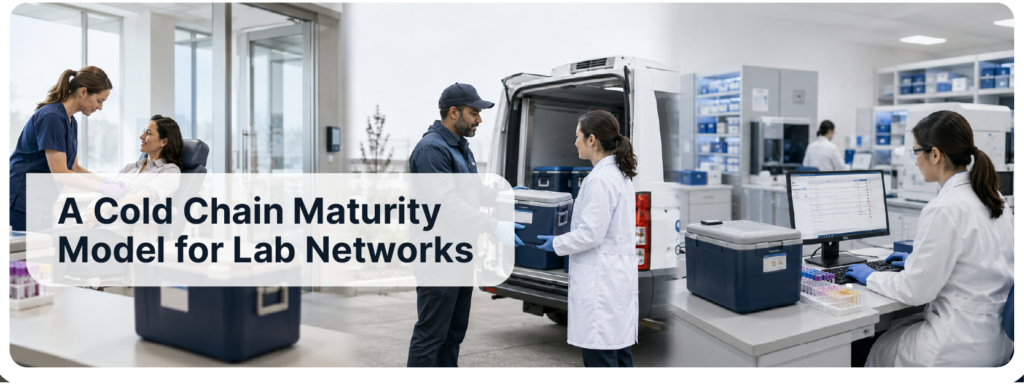
The 5-Level Cold-Chain Maturity Model
This maturity model is a practical way to understand where a lab network is today and what the next improvement step should be. It is not meant to label an organization as good or bad. Most lab networks sit at different maturity levels in different locations.
Level 1: Manual Control
At Level 1, cold chain depends heavily on people, memory, and manual checks.
A site may use paper logs, handwritten notes, manual temperature checks, basic pack-out instructions, and phone calls to confirm status. This can work at very small scale, but it becomes fragile as volume grows.
The problem is not that people are careless. The problem is that the system depends too much on individual discipline. When staffing changes, volumes increase, or new sites join the network, each person may interpret the process slightly differently.
What Level 1 feels like: teams are busy, exceptions are handled case by case, and leaders hear phrases like “we think it was fine” or “we will check the log and get back to you.”
The next step is to introduce consistent monitoring and standard evidence capture for critical shipments and routes.
Level 2: Monitored Shipments
At Level 2, the organization adds temperature sensors, data loggers, or real-time monitoring to shipments.
This is an important step because it creates visibility that manual logs cannot provide. Teams can see temperature history, alarms, and sometimes location or timestamp context.
But monitoring alone does not automatically create workflow control. If data lives in multiple portals, alerts are not tied to SOP actions, and customer proof still requires manual downloads, the organization has data but not yet maturity.
The business problem at this level is alert handling. Some alerts are meaningful. Others may be noisy. If alerts are not classified, assigned, reviewed, and closed in a standard way, monitoring becomes another operational burden.
What Level 2 feels like: the organization has more data, but still struggles to answer what happened, who reviewed it, whether the shipment was accepted, and what changed to prevent a repeat.
The next step is to connect monitoring data to the asset that created the condition and the custody workflow around it.
Level 3: Asset Visibility
At Level 3, the organization stops looking only at shipments and starts managing the cold-chain assets that move and store specimens.
This is a major maturity shift. A specimen journey happens once, but assets repeat. The same lockbox, courier tote, parcel shipper, refrigerated vehicle, or fixed storage unit is used again and again. If an asset performs poorly, is misused, is not conditioned correctly, or disappears from circulation, the business pays repeatedly.
Asset visibility means the organization can answer: where is the asset, who has custody, was it ready before use, how did it perform, is it associated with repeat exceptions, and is it available, conditioned, calibrated, cleaned, and ready for the next use?
An asset-based workflow is a process model where each cold-chain asset type has its own identity, operating state, controls, and evidence expectations.
A lockbox does not behave like a courier tote. A medical courier tote does not behave like a refrigerated vehicle. Fixed storage does not behave like a parcel shipper. Each asset has its own risk profile.
A lockbox workflow may focus on conditioning, access, custody, and dwell. A courier tote workflow may focus on pack-out, multi-stop performance, and handoffs. A parcel shipper workflow may focus on pack-out, storage conditions, transit duration, ambient exposure, and proof of delivery. A refrigerated vehicle workflow may focus on pre-conditioning, route patterns, door cycles, and idle time. Fixed storage may focus on door-open behavior, defrost cycles, room temperature, preventive maintenance, continuous control, and alarms.
What Level 3 feels like: teams can finally separate route issues from asset issues, staging issues, and custody issues. Instead of asking “who caused the excursion,” they can ask “which part of the asset workflow broke?”
The next step is to use asset visibility to standardize workflows, not just report events.
Level 4: Workflow Intelligence
At Level 4, monitoring, asset visibility, SOPs, and exception handling come together into a consistent operating workflow.
A workflow-intelligent cold chain does not simply collect data. It helps teams understand what action is needed and where the process broke.
If a tote goes out of range, the event is connected to the asset, route, time window, custody point, and review process. If a parcel shipper has a conditioning issue, the workflow shows where the preparation failed. If a fixed storage unit alarms overnight, the system captures the event, review, and closure. If a route repeatedly creates dwell at a pickup site, the pattern becomes visible.
Operational intelligence means connecting operational data to the process step where action is needed. It helps the team understand whether an issue is related to staging, pickup, transit, handoff, asset readiness, storage, or receipt.
This matters because the right corrective action depends on the workflow stage. A staging issue needs a staging fix. A custody gap needs a custody fix. An asset readiness issue needs an asset management fix. Without workflow intelligence, teams may keep applying the wrong fix to the wrong problem.
What Level 4 feels like: exceptions are easier to classify, investigations close faster, customer evidence is easier to produce, and teams spend less time reconstructing the story.
This is also where compliance becomes the value-added byproduct. When timestamps, custody, review, and closure are captured as part of daily work, audit readiness no longer depends on last-minute preparation.
The next step is to turn workflow intelligence into a continuous improvement system.
Level 5: Continuous Improvement System
At Level 5, cold chain becomes a performance management discipline.
The organization is not only monitoring shipments or managing assets. It is continuously improving workflows, asset performance, SOPs, packaging choices, training, and exception response based on evidence.
Continuous improvement in the cold chain means using operational evidence to identify repeat failures, fix root causes, standardize successful changes, and verify that the same problem does not return.
A mature organization does not only ask, “Did we close the exception?” It asks, “Did we reduce the chance of this happening again?”
That is where operational ROI lives: fewer repeat exceptions, faster investigations, more stable turnaround times, better asset utilization, stronger customer confidence, less manual evidence work, and better contract defense.
Why this maturity model matters
The same maturity problem appears across healthcare environments.
Hospital outreach programs need consistency across collection sites and courier handoffs. Independent lab networks need control across more sites, routes, couriers, customers, and exceptions. CRO and clinical trial logistics teams need proof, consistency, and confidence across sample movement.
Different environments. Same maturity issue.
When packaging, monitoring, SOPs, couriers, storage, and exceptions are managed separately, leadership gets fragments. A cold-chain operating system brings those fragments together.
Akurasense®: the asset visibility and proof layer
Akuratemp® supports this maturity journey through two connected layers: Akurasense® and Optymiz℠.
Akurasense® is the asset visibility and proof layer. It is not simply about monitoring specimens or courier routes. It provides visibility into the performance and custody of cold-chain transport and storage assets.
That means lockboxes, medical courier totes, home care courier totes, parcel shippers, refrigerated vehicles, and fixed storage can be treated as distinct asset workflows with their own operating states, evidence needs, and performance patterns.
Akurasense® helps realtime, temperature, humidity,light,vibration, location context, custody events, alerts, and exception outcomes into structured operational evidence.
Optymiz℠ is the workflow improvement layer. It helps organizations move from evidence to action by defining the current asset workflow, measuring performance through Akurasense® data, analyzing reliability, recommending improvements, implementing approved changes, and re-measuring performance until the workflow becomes reliable, repeatable, and traceable.
Together, Akurasense® and Optymiz℠ help organizations move up the maturity curve: from manual control, to monitored shipments, to asset visibility, to workflow intelligence, to continuous improvement.
A simple self-assessment
Ask your team: Can we produce shipment proof without searching across multiple systems? Do we know which assets are repeatedly associated with exceptions? Do we know where dwell happens most often? Can we separate workflow problems from asset problems? Do all sites handle exceptions the same way? Do SOP changes reduce recurrence, or only close the current incident? Can we review performance by asset, courier, site, lane, and workflow stage? Are compliance reports generated from daily workflow evidence, or assembled manually later?
If the answers are unclear, the issue is not only technology. It is operating model maturity.
Request a Cold-Chain Maturity Audit
If your cold-chain program still feels like separate packaging, sensor, courier, SOP, and exception processes, it may be time to assess the operating model.
Request a Cold-Chain Maturity Audit from Akuratemp.
We’ll help you map your current maturity level across assets, workflows, evidence, exceptions, and continuous improvement. Then we’ll identify where hidden waste is coming from and what practical steps can move your network toward a more controlled, scalable, and efficient cold-chain operating system.
Because the goal is not more monitoring.
The goal is better control, lower overhead, and continuous improvement at scale.